
TenThousandTokens
Project Overview
Ten Thousand Tokens is a protocol where users must burn their TenThousandTokens NFT in order to launch a memecoin on the platform.
The Idea
- Token launches are competitive, constantly pulling liquidity and attention from one-another.
- The only reason any token takes off is coordination, so what if we could build in this synergy on the protocol level?
- All tokens launched generate fees that go back to NFT holders. By launching, you forfeit fees from all other tokens but earn 50% of creator fees from yours.
- These mechanisms ideally would filter out "low-quality" launches and incentivize holders to work together.
- The NFT collection becomes deflationary, and strengthens the network.
- The full whitepaper is available here.
NFT Mint
- 10,000 NFTs were sold for 0.01e each, with the goal of getting these NFTs in the hands of our supporters first.
- There was a 24h allowlist phase that distributed among S01/S02 NFT holders, $PNKSTR/$CMD holders, and any wallet that holds a NFTStrategy token.
- This ended up being about 15,000 wallets and was oversubscribed. Around 2500 were minted during the initial phase.
- During public, gas spiked and around 100e was burned trying to mint before sellout (which took about 3 hours).
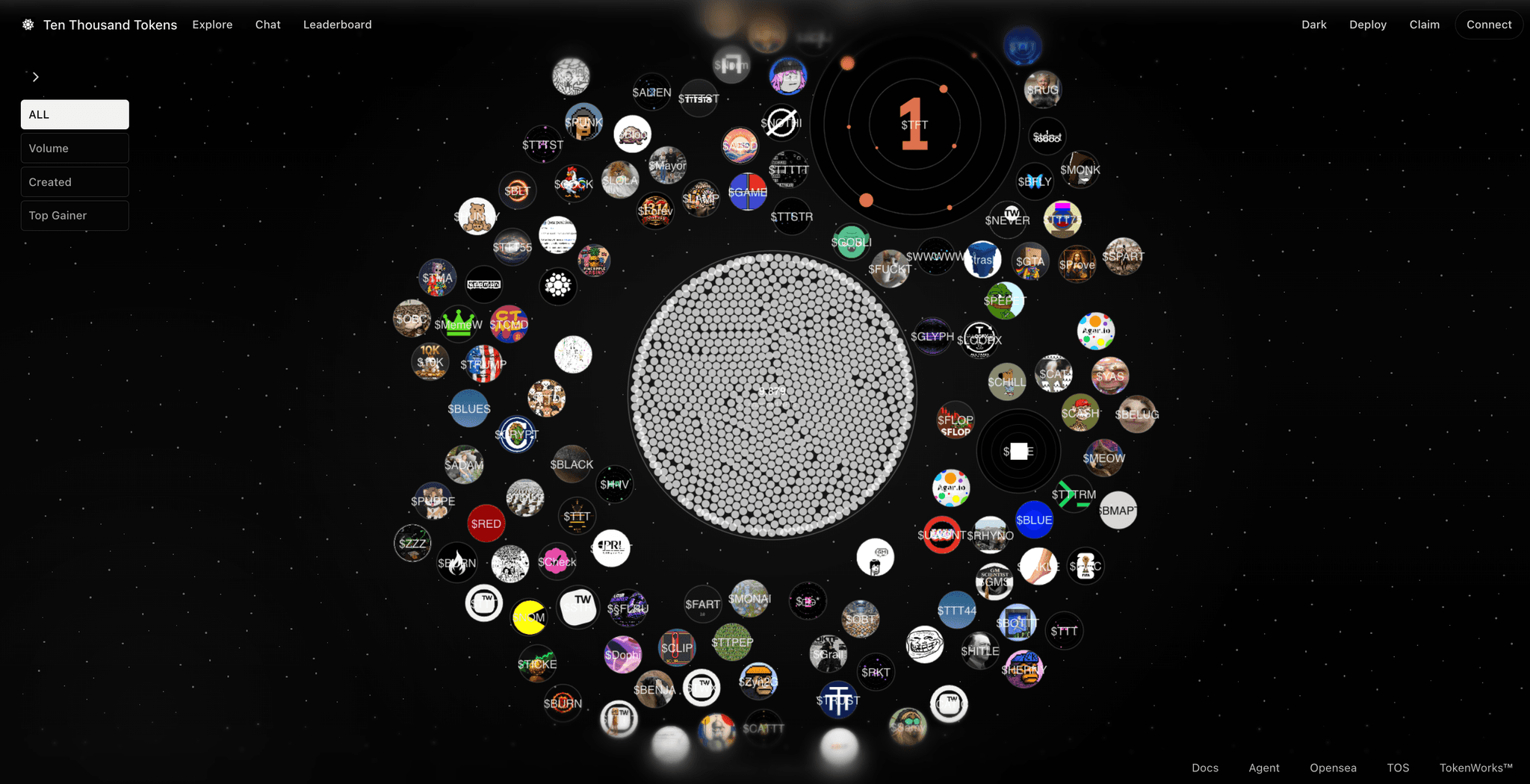
- Each NFT had a visually pleasing onchain SVG as its image. Using Jack Butcher's Avvatar as a base, we added randomized planets and a black background to go with our solar system UI.
What Went Right
- We had a few day buffer period from mint out to platform launch which allowed us to perfect the UI and keep interest going.
- During that time the floor price of the NFTs ran from 0.01e to 0.15e, with over 1,000e in secondary volume.
- At launch, the site worked perfectly and had no (major) bugs.
- We saw 100+ token launches in the first day, with one reaching $1m MC.
- The UI was divisive, with some hating the more artistic approach (which I found refreshing and dopamine-heavy). We eventually defaulted to the "browse" view instead for ease of use.
- There were no contract bugs, and everything runs permissionlessly onchain.
- We added a secondary launch type, a chat for holders, and the ability to update socials for your deployed token.
What Went Wrong
- The crux of the platform failing was there's enough volume for the protocol be interesting.
- 10,000 tokens were probably too many. Most token launches are failures, so a larger number is more shots on goal but it's demoralizing to see such a small amount of fees accrue per NFT.
- It's very difficult to get volume, especially when trying to act above board and not over-promise (I tweeted my thoughts live here)
- We hoped large holders would launch their ideas and rally behind them, but other than a few at launch we didn't really see this behavior and everything deployed after the first hour was pretty much dead in the water.
- All launches had a dynamic buy tax applied, starting at 99% and scaling down to 1%, which we copied from TokenStrategy. In hindsight, that mechanic was solving the opposite problem. TokenStrategy launches often had too many buyers because many projects used it as their canonical token. TTT needed more buyers, not fewer, so the tax ultimately added too much friction.
- Some users experienced issues with swapping, but it was isolated to MetaMask transaction bundling.
Wrap-up
I really like this project in concept, and am sad to see it fail. All in all, we delivered exactly what we promised, and many participants walked away selling their NFTs for higher than mint price. Obviously one man's win is another's loss, but I am happy that we did not overmarket the idea ourselves.
The protocol will still exist for as long as Ethereum does, as it's fully onchain and permissionless. We hope people will still launch on it, as the mechanics still work (even if the network effects didn't). We'll make any changes that we think move the needle, but it's not worth tweaking an idea just for the sake of it.
We've seen a lot of collectors buy tons of these and we see their support and want to make it clear that these NFTs will live on in some way in the TokenWorks ecosystem even if the platform does not. The TokenWorks network has expanded by 2,000 new collectors. We're extremely grateful for anyone who participates in our ideas and do not take it for granted.