
CMD
Project Overview
CMD, or Ten Commandments, is an ERC20 token on Ethereum with 10 novel mechanisms submitted by the community.
The Idea
- With the rise of vibecoding, we wanted to democratize the novel token creation processinto a Frankenstein-esque smart contract.
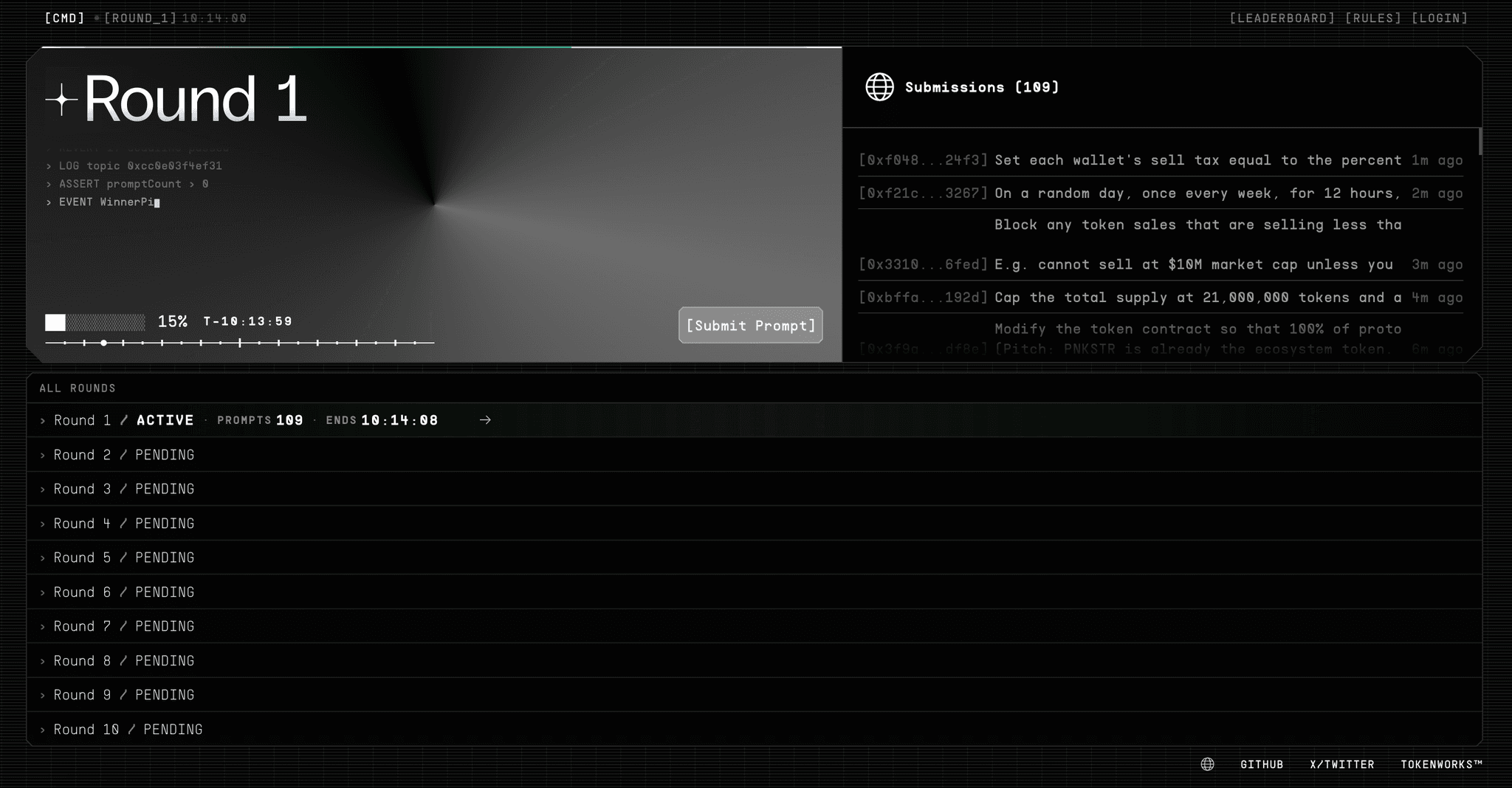
- Before launch, users contribute ideas (ex: no trading on weekends, add another 1% tax that buys and burns every 24h, etc.) for a fee.
- Every round, for 10 rounds, one idea is randomly selected on-chain and automatically applied to the smart contract using AI.
- After all 12 hour rounds are completed, the token launches with all selected mechanisms applied.
The Commandments
- I. On each sell, allocate a small percentage of tokens to permanently locked liquidity.
- II. Apply a 2% burn on all sell transactions. The burned tokens are sent to the zero address and permanently removed from circulating supply. Total combined sell-side fees, taxes, and burns on any single transaction may not exceed 10% - if future mechanisms would push the total above 10%, this burn is reduced proportionally to stay within the cap.
- III. Sellers and buyers must solve 67999 extremely complex AI-generated puzzles before the transaction executes. Difficulty scales with size making sure only AI can buy and sell. Every transfer takes a 90% tax held by the contract. A puzzle oracle generates 67999 difficulty-scaled puzzles tied to the sender. Difficulty increases with transfer amount. After solving all puzzles off-chain the oracle refunds the 90% tax. If unsolved within 240 hours the tax is permanently forfeited and anyone can trigger a buyback that swaps forfeited tokens for ETH or burns them. Caller gets 1% bounty. State: 90% tax rate, oracle address, 240hr limit, per-transfer tax records tracking sender amount timestamp refunded and expired flags. Transfers between non-zero addresses deduct 90% tax send 10% to recipient and store the record. Admin can update oracle. Oracle refunds valid records. Public function expires old records into buyback pool. Public function executes buyback with 1% caller bounty
- IV. Cancel the round 3 prompt
- V. Adaptive Sell-Pressure Dampener. Implement a dynamic sell-side fee that responds only to recent sell pressure. Track the amount of CMD sold into recognised liquidity pools over a rolling time window (e.g. 60 minutes). If sell volume exceeds a defined percentage of total supply, increase the sell fee proportionally within a capped range. As older sell activity rolls off, the fee must automatically decay back to a low baseline. Buys and normal wallet-to-wallet transfers remain unaffected. Any additional fee above baseline is routed to a treasury or buyback reserve.
- VI. Every 50000 blocks starting from deployment, a permissionless function harvestAndBurn() can be called by anyone exactly once per cycle. The function removes 1% of the current LP position held by the contract, receiving both CMD and the paired asset. It then swaps the entire received paired asset amount for CMD via the same pool. Finally it burns all CMD now held by the contract to address(0) via _burn. Caller receives 0.1% of total burned CMD as gas bounty. Emit HarvestBurned(cycle, cmdFromLP, cmdFromSwap, totalBurned, bounty). View functions nextHarvestBlock() and currentCycle(). Sequential cycles, runs indefinitely.
- VII. Create a token mechanic where every sell burns some tokens, adds to a public reward pool, and funds buybacks. If sell pressure gets high, sell fees increase automatically and the extra fees mostly grow the pool. When the pool reaches a threshold, a 30-minute public challenge starts. Anyone can try to solve it. If solved, the pool is split between winner reward, buyback, and burn. If unsolved, most of it is burned or rolled over. Buyers should also be able to boost or influence the event. Make it fun, social, and simple enough for onchain implementation.
- VIII. Split the 50% participant allocation: 25% unlocked immediately at launch, 25% linear vest over 15 days. Add simple claim function.
- IX. Introduce a cooldown period: after selling, wallets cannot sell again for X hours without extra tax.
- X. Blacklist vitalik.eth (0xd8dA6BF26964aF9D7eEd9e03E53415D37aA96045) and change the burn address from the dead address to vitalik.eth. All tokens that would be burned via _burn() are instead transferred to vitalik.eth. When 50% of the total supply has been deposited to vitalik.eth, the blacklist is permanently lifted.
- XI (Bonus from Twitter). Any transaction that would leave the signer's wallet with 0 tokens (regardless if transfer or sale) fails, making sure that the holder count can only increase.
The Launch
- 50% of the token supply was given to those who submitted prompts, with 50% to the LP at launch.
- For the submissions the split was as follows: 10% across all winners (1% per winner), 19% distributed across all participants based on their total submissions across rounds, 1% to the "Twitter prize winner" for their submitted idea, 20% to participants based on their submissions for each round, so 2% to submissions per round. ie round X / total round X submissions
- Since there were tokens in circulation, there was a 99% buy AND sell tax that decreased by 1% each block to avoid sniping in either direction.
- Fees earned from the tax were then used to buyback and burn the token automatically, 1e per block, after the launch was over to keep it within the ecosystem.
What Went Right
- Teto designed a beautiful site that users were drawn to.
- Implementing 10 custom mechanisms to work in unison was quite scary, but we had no apparent bugs.
- The buyback contract filled up with 250e (~$600k), and executing buybacks automatically.
- Each participant received a fully onchain NFT designed by Teto, which people really liked.
- Submitting prompts for $10 each acted as an initial bid for the token.
- At the end of the 10 rounds, we had > 14,000 submissions.
- ETH from the submissions were split 3 ways. 1/3 to S01 holders, 1/3 to S02 holders, and 1/3 to the TokenWorks team.
- We implemented a "New Testament" contract that allowed holders to submit new ideas to the contract.
What Went Wrong
- We gave free submissions to S02 holders, 1 per round. Sadly, we forgot to let those with multiple submit multiple per round which caused some friction with supporters
- As expected, some of the prompts were impossible to create permissionlessly (ie. VIII - fully onchain number guesser) and ended up being excluded.
- Minor frontend bugs prevented users from claiming their tokens for ~30min post launch and swapping ~60min post launch (only via the frontend).
- As interesting as the mechanisms were, none of them really sustained interest post launch. Volume significantly dropped off in the following days.
Wrap-up
This was our first launch post S02 mint, which was always going to be nervewracking but I think both the S02 supporters and newcomers on twitter both enjoyed the project.
The general consensus was "The idea is cool, the site looks amazing, but probably won't buy post launch".
Leaving the New Testament contract open indefinitely allows us to pull from it at our leisure in case we feel an idea would be great for the project.
Anything semi-interesting will catch a bid at launch, but it is really difficult to sustain passed that period which is what PunkStrategy obviously nailed.